Showing posts with label Communication Device. Show all posts

Thursday, March 1, 2018

The Price of Being Different


I hate spending money.

It is the possibility I am reluctant to part with. In my pocket, $20 could be a pack of diapers or a half a tank of gas or a couple of groceries. Once you spend it, all the possibility dissipates. Since I was little, I have preferred saving to preserve option to spending. Spending feels so final, so...decisive.


The topic of money is vulgar to me. Don’t like to talk about it, don’t like to think about it. Do not care for the fact that it is an unavoidable, definitively adult undertaking. It is kind of like toilet paper to me--everybody uses it, each in their own way, but please let’s not discuss the particulars, shall we?


Money is distasteful. On “Cutthroat Kitchen” when the contestants are first handed the cash, what do they always do? They raise it to their face and inhale that horrid smell. The smell of books, new or old, now that is intoxicating--it is the smell of adventure, prose, romance. The smell of money is sweat and butts and squandered potential.


So, if I dislike it so much, why talk about it?


It is one of the things people are most curious about. Probably because it is a borderline taboo subject--it would be impolite to inquire about someone else’s finances, in any scenario. We know the statistics though. Raising a child with special needs or chronic medical concerns is hair-raisingly expensive and we have three. I have panic attacks when confronted with it because need is where possibility and decision collide--inaction is rarely an option.


We have been incredibly blessed. At exactly the right time, the Lord has provided for us, through the kindness of others or an open door, talking to the right person at the right time that points us in the right direction. He has guided us through.


It is a substantial consideration on our part, whether I like it or not, a determining factor in a lot of our decisions. I figured I would offer you a glimpse of the inner workings here, some of the elements at play.


We are a single income family. I have been unable to work, largely due to Gabriel but also because of Benjamin and more recently, Tula. Daycare runs about $35 a day for a decent one, but in this town, the waiting lists are substantial for any reputable child care in town. It amounts to $500-$600 a month, or the bulk of anything I would be able to bring home. Jobs that have the same hours as school can be obtained, but I have to be available to pick up kids afterward or pay for after school care, which would deplete the rest of whatever I could earn. There are no after school programs that accept children with disabilities; there are no after school programs that can manage the girls’ diabetes.


If I could work, Emerald and Tula have to have doctor’s visits every three months; Gabriel has to have doctor’s visits every three months in Lubbock. Which accounts for at least three missed days of work--one to travel to Lubbock, one of the doctor’s appointment, one for the girls if I take them both at the same time--every three months. Those are specialists, they still have to see their regular pediatrician, and like any child they will get sick occasionally.


Gabriel’s school calls an average of two to three times a week for me to come up there. Children with autism often present with chronic gastrointestinal issues and Gabe is not exempt, so often he has had a bad poop and I have to bring him home to shower and return--sometimes it is a blowout, sometimes he gets into his diaper and smears it. Disgusting, but it is something we have to deal with. Other reasons they call are because he is agitated and not calming himself down, he is being aggressive, he is having issues with his clothes or shoes and needs me to deliver new ones, he is falling asleep and cannot keep himself awake, or because he is “just not acting like himself”. Between me and Michael, my hours off are quantifiably worth less than his, so I end up taking off again and again.


Let’s establish--that is just out of the ordinary stuff, not accounting for school trips or class parties and other parental involvement activities, most of which I am still unable to attend because siblings are not allowed (after all, I am of limited help when my arms and attention are full of baby).


We’ll do Diabetes first because I am holding Tula so it makes logical sense to me.


Insurance will cover 100 test strips--the little strips that we use to monitor the girls’ blood glucose levels--a month. Emerald has to test her sugar a minimum of four times a day, six on PE days, for a total of around 140 test strips used a month. Tula has to test her sugar around 6 times a day, for a total of 180. That is if we never get an error reading or they never have high or low blood sugar and never get sick--those all call for additional strips. The test strips we buy--the cheapest on the market--are $0.18 each, for about $40 out of pocket a month after insurance covers $60. Glucometer, the meter that reads the blood sugar, can vary. The ones we use at home the pharmacy actually gave us for free because insurance won’t cover those particular test strips (Glucocard). Insurance prefers the Tru Metrix test strips and meter, so we have two meters for each of the girls at home--one that uses the test strips insurance covers and one that uses the less expensive test strips we have to pay for out of pocket.


To complicate matters, Emerald actually has a THIRD glucometer at school--ReliOn Prime--that we provide test strips for. It is a cheap one, only costing $15 so it can be replaced as needs be.


Tula also has a third monitor, but that one is a combination Ketone and Glucose monitor that we only use for the former purpose. Whenever the girls’ blood sugar is over 300 or whenever they are getting sick, we have to check for ketones in their blood so they do not go back into ketoacidosis. Emerald has strips that you check her urine with; Tula has one that checks her blood. Neither of those are covered by insurance. Tula’s NovaMax Test Strips are around $2 a piece, but will last a few weeks because she doesn’t go high very often. Emerald’s are considerably cheaper at about $0.15 each, but she has to be tested more frequently. Combined, it is about $37 a month.


Lancets are cheap--we use them to poke fingers and toes to draw little bits of blood for testing blood sugar. They run about like $5 for a box, but insurance covers those and they last forever. Alcohol swabs run out quickly and are not covered, $2 for 100 for a total of $8 a month. We use those to clean before we prick or poke and wipe off the top of the insulin. Diabetes logbooks were $5 each and last the whole year. Emergency sugar supplies are like packets of sugar or honey that we have leftover if we eat out, but we could also put dum dums in there. Negligible stuff. Pen needles are the mini needles we put on insulin pens; they are $9 a box of 50 generic. We have to buy four of those a month--insurance covers $36, we cover $36.


Syringes, which we have to use for Teeny Tula’s half dosages, cost $30 (covered) a month.


Insulin gets tricky. Medicinal insulin has been around since the 1900s, so you’d think it would cost less. Generic will actually raise your insulin resistence, meaning you will need more and more over time. We invest in the better stuff. Both girls have Lantus Solostar pens, which are $280 a box. A box has six pens, each with 100 units of insulin. One box will last Emerald a little over two months. Tula has a vial of 100 units that costs $190; it will last her about a month.


Insulin is only good out of the fridge or open for a month so we have to toss it after that or it can jack with their sugars.


That is their long acting “basal” insulin. The also have bolus insulin--Emerald has Novalog Flexpens that are $600 for a box of six pens. Those will last us about a month because she has to take it more frequently, after each meal and for correction. Tula is on Humalog pen that is about $550, but because she eats so very little carbs and only gets the tiniest little doses, it will last her a while.


They both have to have the glucagon emergency kit in case they crash. Most families do not have to use it, but you always have to have it on hand and replace it once a year. It is sort of like an epipen. They are $300 apiece. Zofran is a medicine that will prevent them from vomitting when they are sick because it could cause them to crash which would be dangerous; we get a supply of that a year for $250.


So just for medicine and supplies, most of which is covered (thankfully) under our insurance, runs us about $24,000 a year for both girls. We are personally responsible for about $1500 of that, if insurance is playing nicely and there are no issues.


Emerald’s insurance lapsed last year so we had to pay for it out of pocket for a while; that was kind of killer. I thanked God every day that we were able to do that.


Visits to the endocrinologist happens for each of them every three months; we have no copay, but the visit would be around $120 because they do discounts if you pay up front. That adds up to $960 a year for both. Each time they go, they also have to run full blood work including a1c, totalling around $1000 or $8000 for the year. We meet with the registered dietitian at each visit ($100 an hour, times two for each girl, times four visits a year for a total of $800 a year). If there are no hospitalizations and we keep up with our routine office visits, that is just shy of $10,000 a year.


I don’t want to get into hospitalizations because YIKES and because I am sincerely hoping none of that happens. Normally, we will make an emergency room run once a year because we can’t get things under control and they need fluids or if we run out of insulin before insurance is willing to cover it again. Depending on what needs to be done, an ER visit will set us back about $1200. I also won’t go into things we are not currently doing, like special camps or insulin pumps or continuous glucose monitors because while I could look up the information on that, it would be meaningless--they do not currently affect us.


Whew. That was a bit of an odyssey. Catching my breath before I move on to Autism.


Alright, took a quick Facebook break and now I am back.


Autism Speaks estimates it takes around $60,000 a year to raise a child with autism; $90,000 if the individual also has an intellectual disability. That is roughly four times higher than the cost of raising a neurotypical child.

I did the math after a friend of friend asked me. All things considered, Gabriel costs $46,000 a year more than Benjamin. That is counting incontinent supplies, medication, specialists, therapists, personal care services. Breakdown is something like this:


-Personal Care Assistant: $1000/month ($12,000/year)


-Incontinent Supplies (diapers, wipes, changing pads): 200/month (2400/year)


-Medication (clonidine, risperidone, hydroxyzine): 450/month (5400/year)


-Therapy (speech, occupational, physical): $28,800/year*

*This one actually went down substantially because we cut back—insurance doesn’t cover Applied Behavior Analysis so we had to pay out of pocket for each session; got too costly and we had to quit. We also scaled back, dropped PT at home, decreased at PT/OT school so that he could have a little break. It was getting to be a lot.


-iPad maintenance and repair: $130/few times a year. Because it’s his communication device, we have kept it available, but that means it has had a few accidents. He ruins cases, takes it into the bath with him, leaves it outside, or gets mad and cracks the screen. Currently, he’s taking a short break from screens because he has annoyed us too greatly by being uncareful. It also covers new chargers.


-Specialists: $250/visit($1000/year) he see a developmental pediatrician, which we have to travel to Lubbock for, so tack on another $40 in gas.


There are other costs like locks for the fridge and pantry, bolts for the front door, back door, and our bedroom door. We get items to work with him between therapy—trampoline, swing set, weighted blanket, compression garments, sensory brushes, hammock, exercise ball, privacy pop, noise canceling headphones. Those vary in price from $10 to a few hundred. We were doing horse therapy for a while, but have taken a break. That was at no cost.


All of that adds up to...right under $50,000 annually for Gabe, before calculating for lost wages. As he gets older, the price will increase exponentially to include a nurse or residential living (though we hope he wants to stay with us), transportation, and other expenses.


I try not to think about all of this, but when it comes together…


Yuck. No wonder I don’t like thinking about money.


When I do think about it...it’s a tangible, definable way to express how God has cared for us. A lot of families of special kids go bankrupt trying to handle it all; though we rarely have excess, we always have what we need when we need it. I think that is such a beautiful thing. I am very thankful for it, because it once again opens my life up to possibility.


—Andie

Wednesday, December 7, 2016

Bumblebee's Greatest Hits


The goal of communication is to have your needs met--babies cry, which they learn parents will respond to promptly with food and clean diapers and whatever else tiny baby hearts might fancy.

When we hit the metaphorical wall where the manner in which we were expressing ourselves can no longer adequately satisfy those needs, we have to adapt, figure out a new way to get what we want. The same goes as we grow and develop more complex desires not as easily conveyed.

Gabriel, the exceedingly clever duckling that he is, has had to constantly devise of new and more elaborate manners in which to express himself without formal, traditionally acceptable communication (words, signs, picture exchange, etc). He will drag us to where he wants us to go and put our hand on what he is requesting, mime the action that he wants us to take, or bring the desired object to us.

His latest and most ingenious communication method has earned him the nickname “Bumblebee”.


Of the “Transformers” mythos, Bumblebee is an autobot that has been depicted as having a battle injury that resulted in the loss of his voice. In the Michael Bay movie, Bumblebee utilized cobbled together expressions from radio transmissions and songs to gain some semblance of speech.

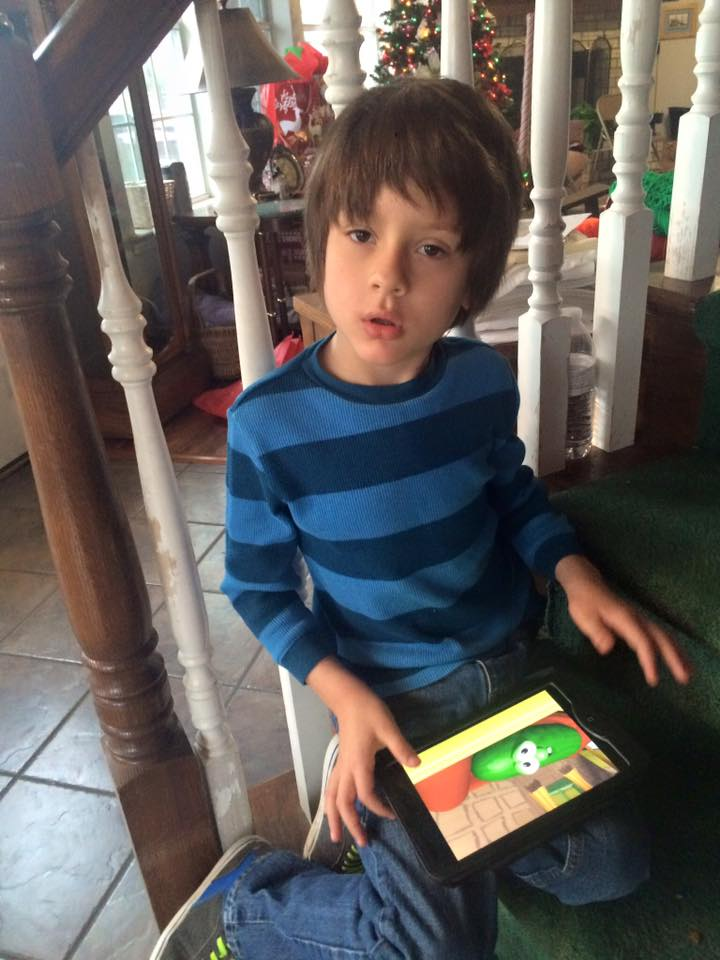
With a remarkable memory for what he has watched and access to almost unlimited video material on his iPad, Gabriel has often found just the right phrase to repeat again and again in a given situation to communicate his thoughts on the matter. This has led to some funny, heartwarming, and overall impressive interactions we would have otherwise missed. So I present to you: Bumblebee’s Greatest Hits

Scene: Michael has just served a beef fajita dinner that he prepared.
Line: “I’m not going to eat garbage, Dad” (Ratatouille, 2007)

Scene: Michael, Gabriel, and I are driving to Lubbock to visit Michael’s family.
Line: “We’re all gonna die!” (VeggieTales: Pistachio, 2010)

Scene: The speech therapist was annoying and frustrating Gabriel by making him work; after he got his iPad back, she asked if they were still friends.
Line: “Since God has forgiven us it’s true, You forgive me, I’ll forgive you” (VeggieTales, “The Forgiveness Song”)

Scene: Having woken at the exceedingly appropriate hour of 2 am, I made Gabe lay still and quietly next to me in bed until 6.30 when I let him get up. I set him up with breakfast and gave him his iPad.
Line: “That was the WORST night of my life, BAR NONE” (Monsters Inc, 2001)

Scene: I have just served Gabriel lunch.
Line: “Ah, it’s the thought that counts.” (VeggieTales: Lyle the Kindly Viking”)

Scene: ???
Line: “master made me this collar so that I may speak” (Up, 2009)

Scene: My mother, who has been serving as our personal care attendant, frustrated Gabe by saying he was all done with snacks.
Line: “Bye!” (VeggieTales)

Scene: Emerald and Gabriel are playing together in his room.
Line: “Oh! Would you look at that? Don’t be selfish” (King George and the Rubber Ducky)

Scene: Gabriel was having a rough morning emotionally, lots of meltdowns; we got Taco Bell for lunch so we wouldn’t have to cook.
Line: “I feel really happy and I don’t know why”. (Minnesota Cuke)

Line: Just like my mom and dad, they love me very much. (VeggieTales).
This was repeated until Michael said, “mom and dad do love you very much, buddy”.

Scene: Following Emerald around the house.
Line: “God gave us families to help each other. The very best way for you to show love to your new little brother is to think about him first.” (Duke and the Great Pie War)

Thursday, August 4, 2016

A Day in the Life

Prompted by my dear Karla Black, who asked: What is your typical day?


Our day starts precisely when Gabriel decides it should. He is our rooster of sorts, for whatever time he has deemed appropriate on that particular day is when he--and consequently the family--rises.


If his tablet is within reach, he will turn on his shows at maximum volume (so that every family member may enjoy) and wander up and down the main hall of the house, laying down with each of us in turn until we all resign ourselves to being up for the morning. This usually occurs somewhere between the hours of midnight and 6 am.


If Michael or I has had the foresight to plug in the iPad the night before, Gabriel assesses his immediate needs. Is he hungry or thirsty? Then his first stop becomes the kitchen, where he jimmies the lock on the fridge or hulks the door off the cabinet in order to obtain something appetizing; this (if he is able to open on his own), he dumps the entirety to the kitchen floor, eating perhaps 1/18th and smashing the rest beneath foot. Should the tantalizing treat be too tricky to open unassisted, he brings it to his somnolent parents and throws it atop us, repeating as often as necessary to achieve desired results.


When urination is his first and primary concern, he will lay down next to his father, nestle close beneath his arm, and let loose the golden rinse (the outcome with mom on similar treatment has been met with angst and ire, prompting young Gabriel to avoid her for this particular need).


Mostly however, he will lay between Mom and Dad and spin and cackle like a drunk witch performing broomstick-barrel rolls.


Michael and I are then grudgingly up for the day.


On a typical summer day--let’s say it is a Monday, as our schedule is fairly static at this point but differs from day to day--I will go wake the remaining two rather grumpy children at around 7 and instruct them to dress before I go to the kitchen to start making breakfast. Dressing is an activity I do not have to oversee for them because I have simplified the process: on every hanger in their closet, there is an outfit complete with shirt and matching pants.


After changing Gabriel’s diaper, Michael will prep the dose, dissolving a risperidone pill in a small amount of soda/juice/gatorade, really whatever we have on hand. Risperidone is an antipsychotic that helps control the extremes of autistic behavior. Michael then goes to do his morning routine.


Breakfast nearly ready, I call for the kids to wash their face and hands and for Emerald to do her finger poke--it tells us where her blood sugar is at. She tells me her number and calculates how much insulin she will need to give herself to cover her blood glucose. I tell her how many units she needs to cover her meal, which she adds to her number, and administers her fast-acting insulin, Novalog. (For example, she gets 1 unit of novalog for every 50 over 150 that her blood sugar is,  up to 5 units; if her blood sugar is below 150, she receives no insulin for that portion. She also gets 1 unit for every 20 carbs she eats. Say her number is 150 and her meal was 60 carbs; she would give herself 1 for her blood sugar and 3 for her meal for a total of 4 units of insulin before breakfast.)


Michael meanwhile has gotten ready for the day, so he dresses Gabriel and administers the dose of Risperidone combined with Quillivant, a medication used for ADHD, while I make plates. The kids file into the kitchen to pick up their breakfasts. If we have nowhere to be first thing in the morning, we take our breakfast picnic style in the backyard while it is cooler. This week, we actually had food camp for Gabriel so we let the kids eat alone at the kitchen table while I get ready to go.


But food camp is not every day, so back to our regularly scheduled Monday.


Daddy kisses everyone goodbye and heads off to work while we sit in the sun and enjoy our meal. I spend the next hour cajoling, coaxing, and convincing the children that fresh air and exercise is good for them while they lay in the grass and complain that it is too hot and that they want to go inside, their legs are tired and why can’t they play with the hose.


Upon returning to the house, they begin the chorus of “why don’t we ever go anywhere or do anything fun?”


This is our cleaning time. I send Emerald and Benjamin to picking up toys, putting laundry in the baskets, and putting away their belongings from the main rooms of the house. I will occupy myself with laundry or dishes, stopping every few minutes to check on my sweet little ducklings, who are happily singing as they joyously and lovingly put away their belongings.


Right. In truth they are laying half draped off their beds, bemoaning their difficult lot in life, cursing the cruel fates that have stuck them with such a meddlesome mother, and emphasizing how exhausted they are from the undue burden I have placed upon them.

The house (passably) clean, I send the kids to play while I try and get work done for REACH. Depending on how much I have going on, I may have to skip the cleaning that day and just focus on getting as much done as possible. Currently, I am corresponding with local agencies to get informational brochures and flyers for the resource packet I am assembling.


Depending on the weekday is which therapist we see. Mondays and Wednesday is Speech; our sweet Speech Language Pathologist (SLP) comes and attempts for a half an hour to teach Gabriel functional language while the siblings desperately vie for her attention. (And let’s be honest, I am, too.)


Lunch time, Michael generally comes home from work. To maximize his time here, I usually have something prepared and ready to go when he walks in the door. Emerald does her song and dance routine of diabetes again with the fingerpoke and the insulin shot and everything. Either Michael or I prepares the second dose of the day, a risperidone and clonidine. Clonidine is a blood pressure medication that helps Gabe sleep.


Gabriel has not yet learned to sit down during mealtimes, preferring instead to wander the length of the house. He will use his entire fist to scrape a handful of food off of his plate (thankfully, he is not a particularly picky eater) and attempt to transfer as much as he can into his mouth. A significant portion ends up on the floor, walls, furniture, and his person; he requires a full bath after most meals.


Possession is also a concept that is beyond him, making it difficult to identify which food is “his” and “not his”. Whichever plate is closest is the one he will remove food from. We have progressed to the point where he will primarily steal from Benjamin exclusively, Mom and Dad being persons you do not cross and Emerald having developed impressive protective skills. This causes great consternation to our youngest, who will scream, cry, stomp his feet, and holler “NO GABY!” approximately ten thousand times per meal.


One trait of autism can be “dumping”, where the child upends containers to spill the contents about. Gabriel is a devout practitioner of this particular custom, letting us know that he is finished with his beverage by pouring it to the floor and throwing the cup atop it. His food likewise will be upturned onto the table and spread about for maximum coverage.


While one parent cleans up Gabriel and sets him up with his tablet, the other lets the dogs in to clean up the mess. Depending on what we ate, there is a fairly significant amount that did not end up consumed. Everything has to be cleaned and wiped down before it sets in and becomes a total pain to scrub off.


Michael heads back to work and I lay the kids down for nap. This quiet time is really mostly for me--I need a few minutes to reboot, have quiet thoughts and recenter myself before facing an afternoon with the gremlins. During this time, I may write or start prep for dinner, do laundry or dishes. If it has been a particularly hard day or we were woken particularly early, I may play a video game, read a book, or take a nap. This is a very good time.


Nap time can’t last forever (no matter how much I want it to) and we head outside for snack. During the summer, it is often popsicles because of the low sugar content and how refreshing it is. If I am feeling particularly amiable, I let the kids put on their swimsuits and play with water guns, water balloons, or the sprinkler in the backyard.


Dinner on Monday has to be fairly prompt a little after 5 so that Michael can take Gabriel out to Buffalo Gap for therapeutic riding. The kids are banished to play, read, or quietly engage themselves while I cook. Gabe’s third risperidone is prepping on the fridge.


Emerald does her third fingerpoke and shot of the day, we repeat the chaotic food flurry from lunch ending in the same mess, letting the dogs in and cleaning Gabriel, wiping everything down.


Buffalo Gap is around 25 minutes away from our house, depending on traffic and the route you take, so Michael leaves with Gabriel at around 6.30. If they have been exceptionally good that day, Emerald or Benjamin might get to go as well, but I like to use this as Gaby/Daddy time.


While they are gone, Emerald and Benjamin get baths. Benny is still in the phase where he hates to get his face wet; it is a lot like bathing a cat, him clawing to get out and you trying to wash whatever you can reach and atttempting to keep the howling child in the water.


Kids ensconced in pajamas on the couch, we cuddle and watch cartoons and wait for the rest of the family to come back home. I have got Gaby’s last dose of the day--two clonidine--cooking on the top of the fridge so we can administer it as soon as he walks through the door. After bath, Emerald did her final finger poke and shot of the day, this time the long acting insulin Lantus. That amount stays the same every day, regardless of her blood sugar--9 units, every night at 7.30.


Michael walks back through the door, sweaty and exhausted. Gabriel is considerably calmer than when he left. He gets his dose, and the four of us--me, Mike, Emerald, and Benjamin--trudge off to the back room to all put away the laundry I have been folding all day. Emerald makes the beds that Gabe has pulled the sheets off of, Ben hangs up things for me and puts them in drawers. (Or, more likely, throws them on the floor where I can pick them up and wash them again the very next day).


Gabriel’s sleepy time medicine takes an inconsistent amount of time--it could be an hour, it could never kick in and he just powers through it. The latter is becoming less common; he usually has to be pretty worked up to burn through the dose, and we have gotten pretty good at keeping him calm.


Perfect world, he takes the dose at 8 when he gets back from his horseback riding and falls asleep around 9-9.30. Clonidine seems to make him thirsty, and he’ll drink 4 or 5 cups of water before falling asleep. We have to be careful and change him before he gets too drowsy or he will pee out while he is sleeping or wake up when we change him and never calm back down.


But perfect world, so he is asleep at 9. The other kids have been sent to bed at 8.30, so Michael and I get to snuggle on the couch and fight over the xbox. He lets me win, and watches me play Fallout 4 until I start falling asleep on his shoulder around 9.30 or 10.


I kiss him goodnight and go lay down, knowing the next day will start anywhere in between 2 and 8 hours.

--Andie