Showing posts with label Christian. Show all posts

Monday, February 26, 2018

The Way I See You

“People think pleasing God is all God care about. But any fool living in the world can see it always trying to please us back.”― Alice Walker, The Color Purple


My Benjifriend is down sick today, so I had to stay home with him and miss out on church. As Michael can tell you, I took this news rather...immaturely because I didn’t want to miss service. I like going to church. It is a happy place for me, full of good things and good people. People that do not want to have themselves or their families exposed to my wee babby’s biological warfare. So, I will sequester myself this Sunday feeding him the medicines of my youth--7-up, reruns of Price is Right, and saltines--and bring him back when he is safe to be around other people, and I will use this quiet opportunity to listen to my Ludovico Einaudi and write in peace. (If you want to hear it as I wrote it, listen to "I Giorni"--https://www.youtube.com/watch?v=Uffjii1hXzU.)

I am an optimist by nature. I want and choose to see the beauty and goodness in the world; it feeds the hope that lives inside me, the whisper that says, “Wait. The best is yet to come.”

When I was younger and my faith was the sum total of all my parts (a place that has slipped through my fingers to make room for life; a place I have been trying to get back to), my heart’s desire was to see as He sees, to view the world not through the distorted vision of opinion but in truth and reality because it was as He made it. As many that have gone before me, I found the most pure, tangible connection through nature. I lay in the grass, feeling the heat the sun had lent the ground seep into my cold body. I imagined it was healing me, dragging doubts and fears and darkness down and dispersing it far below where I didn’t have to feel it anymore. At just the right time, when my skin was glowing golden from the warmth of the day, a breeze would stir and carry me away, away with the leaves and the caterpillars on their silken strings and the motes of dust that made the air sparkle like glitter.

God intended so much more than this for us. We know that; we can feel it, read it, experience the separation that sin caused. It is easy to forget that He meant more for nature, too.

He made this world to walk in with us. He made it and named it good because it pleased Him. It was a paradise He wanted to share. I can envision how eagerly He would anticipate the delight on our face when we saw for the first time the snow falling on the mountains, a hummingbird sipping from honeysuckle, the ocean washing up on the shore. In His garden, I could have bear friends named Otso and Mischa that I could hug and feed sweet potatoes and nap with in the sun.

I would have really liked that.

The Bible says that Adam and Eve disobeyed and ate the fruit, setting off the chain of events that has somehow arrived in a place where Andie does not get her potato-eating pet bears in the sun. Lady days suck and we have to toil and work and things are hard and they suck and what could there possibly be to be hopeful for?

To me, salvation is a not a story that is finished yet. Our brains hate things unfinished, which is why it wakes you up in the middle of the night repeating “This is the Song that Doesn’t End” because why doesn’t it end?! Brain likes to be able to close the box and say, “this is complete”--this story is done, the task is finished, the song is over. It bothers us endlessly to leave things open because it is still waiting, waiting to be attended to. It would be so much more comfortable for us if the Bible was self-contained, starting with “in the beginning…” and ended with “Amen”. Close the book and put it on the shelf; it is done. It relieves us of the burden of becoming.

It is so exhausting to be unfinished.

If that was all there was, the stories related to us of God working in the men and women of the Old Testament to culminate in the birth, life, and death of Jesus Christ, everything since is just an reverberation of that defining moment. We are living in the aftershocks of God’s dramatic crescendo, and thus relieved of being or becoming anything more than what we are. Why bother; Jesus said himself, “it is finished” (John 19:30). Show’s over, time to go home. Everything since is inconsequential, our lives and our actions amount to nothing, and nothing matters.

Nature shows us that it’s not over. He still cares; He’s still trying—He is still making something out of nothing, propelling us toward something more. The story didn’t end at the cross, but started there and continues on through today and into infinite tomorrows. If Jesus was sent to bring us back, then we still matter enough to try for.

So many of our opinions of ourselves can be so brutal. How is it so instinctual to tear ourselves down? When the voice in our head is dogged and determinedly repeating how we are not good enough, not strong enough, not smart enough, not brave enough. We just aren’t enough.
The part born inside is there to remind us that we weren’t meant to walk alone. God always meant to be right there beside us. He meant friends and family to love and surround us, to encourage and support one another. Our souls remember and remind us—

We weren’t meant to walk alone.

How joyous it is that partnership! How wonderful it is that He has never left us, will never leave us! I have taken great comfort in that.

As my relationship with God grew, it stretched to encompass humanity in my desire to see as He sees. We are separate and apart from creation, made special by His design, but we are also part of it. We are exhibits of His glory, too. It is difficult to see His face reflected in the actions of man, but I had to remember—in the Bible, we saw God’s chosen people turn away again and again. It was in the individual stories where we saw the most change, God working directly on hearts to better the situation for the group. It was through David, through Rahab, through Moses and Elijah and Deborah and Esther, that God led and delivered His people, and it is through those stories that we see His intent for our lives.

God loves us so much it hurts. I truly believe that. He’s so proud of us. I feel like if He had a wallet, He’d have our picture in it and show it to everybody at the grocery store. “See that Andie? She’s got FOUR kids now, can you believe it?” He isn’t sitting up there grouching about how little we visit or fuming that we messed up again. He’s hoping I got the sunshine He sent today, that it made me think of Him and brought a little smile to my face because He loves my smile.

God’s reality is that He made all of these people and He loves them, so He wants us to love them, too. I mean, He may have mentioned once or twice. That attitude  is what I strive hard for every day.
It’s hard though. Sometimes my emotional, opinionated side flares up and clouds my view of a person, leading to arguments with the Voice in my head I call God that go like this:

I don’t like them.
I made them.
Well, you did a bad job. I hate them.
I love them.
...okay, fine. I don’t hate them. But they need to be smacked.
About as much as you need to be smacked?
….that was uncalled for -generic grumbling-

Since first joining social media, I have wanted to make a post encouraging us all to share our genuine opinions of one another. In the idealized, romanticized version in my head, it would a platform for people to share how much they admired other people, how they wanted to know them better or had little crushes on them; fun things that show you how others viewed you.
My hesitancy was born in that more realistic voice in the back of my head, the one that has seen all the “Roast Me” posts on Reddit.

Do not ask for honesty if you are not ready and willing to hear the ugly, untarnished truth. My hope would be that people recognize that we all have so many negative thoughts about ourselves that we don’t need anyone to add to that. As I cannot control the direction the post will take (likely it will die on arrival; most posts that require interaction are bypassed all together), let’s not take any unnecessary chances, shall we? All I have power over is my own opinions.

Through this screen that I have carefully constructed, using what I believe of God based on my personal relationship with Him, I see you.

To me, you are the most interesting person. I love to hear stories an out your life, your family, what you wanted to be when you grew up and what your favorite things are and why you think and feel the way you do. I want to see who you are, the things that drive you, inspire you. I could listen to you all day.

I’ve seen you struggle, and my heart ached for you—I see how hard you are trying. I’m so impressed with the strength and dignity you have displayed, handling what life has thrown at you. You are so tough, so strong, so brave. I don’t have to worry about you because I know that you can overcome any obstacle, but I am going to be here to help you in any way that I can because we are stronger together.

I have prayed for you, through sickness and hard times, but in the good times, too. I pray that you feel safe and loved and happy, that you see God working in your life and it brings a smile to your face. I pray that you have everything you need, and some things you want as well. My heart is so filled with hope for you, because I know:

The best is yet to come.

—Andie

Wednesday, February 7, 2018

Daydreams

It is my dream to own a home one day.

When I am laying awake at night trying to relax enough to sleep, I think about what it will look like. What colors I will paint the walls, how I will decorate. What it would be like to have holidays there, and that feeling of “coming home” the kids will have when they’re grown and visit.

I joke with Michael that my decorating style is “teddy bears wearing dresses”, but I could better describe it as Parsonage, that mid-century time capsule, intangible and universal grandparent home.

It is always warm and there is so much sunlight streaming through the curtains. You can see the little floating particles in the air and it’s kind of magical, like everything has slowed down around you. There is a sitting room near the front door with that couch that looks like it has never been sat on, and every item looks like it has a story to tell. The furniture and decor is a mishmash from all decades, but all of it is so lovingly cared for--they were bought not for a season, but for a lifetime. This is a place where prayer happens, where faith is practiced. It has a feel of Sanctuary, a place of calm and quiet and rest, light and life and love.

To me, that is what home is supposed to be. A peaceful place.

I think it has a lot to do with my particular view of God. Since I was a little girl, I have been inexplicably drawn to the idea of The Fountain. I remember when I was about seven or eight, we were singing the song “There’s a Fountain Free” as the invitation at my hometown church. It was in the old auditorium because we hadn’t built the new one yet, so it was all that red on red on red--red bench-style pews, thin red carpet, like you had been swallowed whole by some Lovecraftian beast. That was my favorite color. We were singing this song and it doesn’t make a lot of sense to me:

There’s a fountain free
Tis for you and me
Let us haste oh haste to its brink.


My grandmother has this voice that is legendary within our world. It is clear and strong, unmistakable. When she sang, I imagined angelic choirs in white robes and golden glow, trumpets, the whole nine yards. She was singing this song and it hit a line: Thirsty soul, hear the welcome call--tis a fountain open for all.

I don’t know why it struck me so hard. This was post-cat-exploding on me so I was familiar with the concept of death and heaven, though I had not yet lost anyone close to me. (I come from long-lived stock.) There wasn’t a definitive time that my parents sat down with me and we had the life and death talk like you see in sitcoms; more of an ongoing exposure through church that beyond this life, there was something waiting.

New places and new experiences are not things I actively seek out, so even then, this idea was terrifying. The beautiful language used to describe it, from pearly gates to golden streets. Growing up in a modest home with a modest family, these were not concepts I was actively familiar with. It sounded foreign and massive and intimidating. I pictured dirty and scraggly me not being able to fit into this heaven, too plain, too simple, too ...little.

To hear it described as a fountain, I suppose ostensibly I was supposed to combine it with the other ideals and envisioned a grand water feature a la the Trevi fountain, something awe-inspiring, but I didn’t. To little seven or eight year old Andie, the “living stream with a crystal gleam” was more private, natural, a place where maybe I could fit in, too.

God is often thought in these vast, monumental terms. We think of Him as the creator of the heavens and the cosmos; He who holds the earth in his hands and made the seas and the skies, caused the mountains to rise and can command them to fall again. This big, big God that does big, big things.The perpetual runt of the litter, I didn’t feel like I could fit into that version of God because I am not big big people, capable of big big things. He made the little things too, though.

He crafted bumblebee wings and strands of hair, specks of dust. He made many and much, and little and enough. It is in His power to fashion an infinite heaven of mansions, gilted roads and jewel-encrusted entrance. And if He could do all that, He could make a place for one dirty, scraggly, small Andie.

I am not in any kind of hurry to buy a house. There is no urgency--I watch my house-flipping shows, kind of a little sad as they rip out beautiful floral wallpaper and carpet that looks like it would be so soft under my feet. They make the homes a little colder in my eyes, more impersonal, with granite counter tops and open floor plans, and rob it of all the cozy warmth of it. My tastes are far from fashionable, but I am patient--trends change, and it’ll come back around again, I am sure. Michael and I go on dates to open houses, holding hands and talking about the house we will grow old together in. And at night, I have my daydreams of planting a garden, reading in the sunlight, decorating Christmas trees, making memories.

There is no urgency because I trust that God is making a place for me. Not just a place beyond, the fountain of rest, but somewhere earthly. Every time we have needed a place, God has provided--when we got evicted from our dank and dingy apartment, there was a beautiful yellow house on a quiet street for us; when it was time to say goodbye to Lubbock, we were blessed to find a rental right by Michael’s new work in Abilene. Proximity lead us to our new church home, a building that embodies everything I dream about--the sunlight and the peace, the feeling of belonging--and a church family that has blessed us so greatly, supported and loved us through our crazy lives and crazy family.

So I can wait. Because I know when it happens, it will be better than I could have ever dreamed. --Andie

Sunday, September 11, 2016

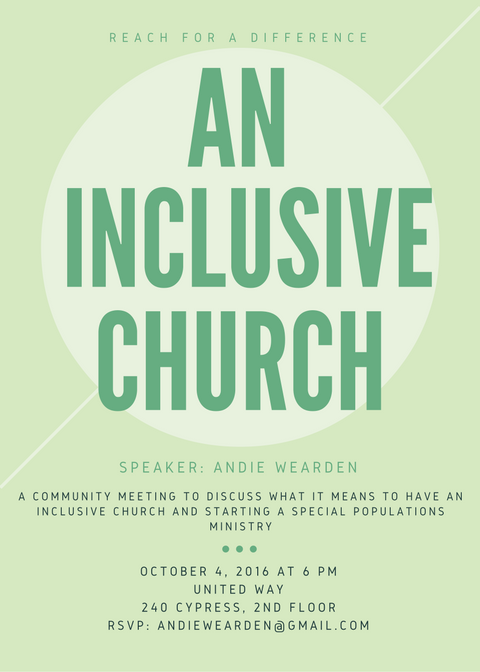
An Inclusive Church

inclusivechurch.png


At the October REACH community meeting, I am the speaker. As with most things I do, I am not really certain how I ended up in the place, likely from a single offhanded comment that I enthusiastically ran with, but I have thrown myself into it with my usual vigor.


The subject is “An Inclusive Church”--making churches safe and welcoming places for individuals with special needs.


I am FAR from an expert on the subject. I have no formal training of any kind on really any matter. That part is kind of making me nervous. Public speaking doesn’t bother me; I get antsy right before, but once it comes down to it the combination of my extensive research and practice combined with my inherent passion and earnestness wins out.


Above all, I want to have something worthwhile to say. This conversation needs to happen. Statistics have shown that 90% of families with a disabled member do not have a church home. When you’re talking about nearly 1 in 5 American families, that is a genuine problem.


What is keeping these families out of the church? What can we do to fix it?


What makes me think that I will have anything worth hearing to say on the subject?


I do have my own experiences--one bad, three good--since Gabriel was diagnosed. My observations. And one sad fact: I do not know a single special family, my own included, that has not been asked to leave a church.


We wanted the kids to grow up going to Sunday school like we had, but we were having trouble finding the right fit for our family. Michael and I were young, 24 and 22 respectively, and our religious beliefs were still solidifying, not yet quite fully realized. Both of us grew up in the Church of Christ, learning roughly the same basic traditions and beliefs and practices; we expanded on our well of knowledge at LCU with more challenging advanced theological study (Michael being a youth and family ministry major for several years, he was exposed to more than I was). We were at the point of sifting through all that we were taught and holding it up to our own interpretations to see if we could figure out exactly our particular brand of Christianity looked like.


In Lubbock, I can remember maybe four or five big Church of Christs. We chose ours based on proximity more than anything else, I would imagine. Being relatively awkward socially, I struggle bonding with new people and I had not made friends; Michael is reclusive by nature and is comfortable being on the outside looking in. So though we had attended off and on for a while, we really hadn’t connected with anyone or found our niche.


It shouldn’t have hurt when they (kindly) suggested we worship elsewhere then. I remember sitting there, confused by the language and not really following what was being said. My ear hurt; was I getting an ear infection? I didn’t want an ear infection. What do they give you for one if you’re allergic to penicillin? That was what I was thinking while Michael held my hand and I nodded when it seemed to be an appropriate time and made vague sounds of consent.


At dinner at Michael’s parents later that night, he was telling them how the kids would not be welcomed back to the church’s parents-day-out program the upcoming semester, how they had suggested we would be more comfortable in a different congregation. I remember being confused, arguing with him. That wasn’t what they said, was it? I thought we were just discussing Gabriel’s problem behaviors again.


We had several meetings like that over the course of the year that he had attended there. They were scarcely productive meetings. I had found out a literal hot minute ago that Gaby was autistic--following their recommendation to pursue testing. They were asking me for tips and strategies on how to deal with it.


Why did they think I had the answers? They had more experience, knew more about it at this point than I did!


We would sit there in another one of those interminable meetings, discussing a plan like I knew what I was doing, wide-eyed and pleading because I didn’t know what to do and this was my life now. I didn’t have any answers, I didn’t know who did. This massive, scary thing was crushing down on me…..

...and they were telling us to get out.


No matter how kindly or well-intentioned that was, it SUCKED. They had told me I needed to get Gaby tested for this, and when I did and it turned out he had it, they didn’t want us anymore.


We were devastated. It is like being broken up with. Doesn’t matter that you knew they weren’t the one for you, that it wasn’t going to last forever. It still hurts when they say it is over.


There was a lot I didn’t like about that church. I remember wandering around that first Sunday looking for a class and no one seemed to notice or care that I was there. More sermons than not we had not necessarily agreed with. It wasn’t a bad church, it just wasn’t the right place for us. And the longer we stayed, the more obvious it was that we didn’t fit in.


It took us awhile to work up the courage to try the place they had suggested. Why bother? So they can kick us out, too? Besides, it is way across town and we have heard that it is fairly -whispers “liberal”-. Yeah, I don’t know. That doesn’t sound like the right place for us.


Emerald kept asking if we were going back to bible class though. That is a hard thing to listen to, but what is even worse is watching her face fall when you say, “Not today, honey” week after week. The death blow is when she just stops asking.


So we swallowed our hurt and pocketed our fear of rejection, and we showed up the next Sunday hoping for the best.


How so delighted they were to see us, like they had been standing there holding those doors open just waiting for us to come in all this time. The church is far from small, boasting hundreds if not thousands of members. But they noticed that we were new, and wanted to make us feel welcomed and wanted.


The special needs minister took the time to talk to us, get to know our family and introduce us to the other families like ours, making sure to invite me to the mom’s support group. No chance at being a shrinking violet here because there were so many people that wanted to talk to you, get to know you.


We went to that church for several years, until we moved from Lubbock to Abilene, and during that time I fell in love with it. The teachers for the adult classes were so intelligent and had such engaging discussions--no fluff-piece, baby food lessons. They wanted you thinking, talking, participating. We were making friends, both through the mom’s special needs support group and also through our bible class, who seemed like a big group of best friends.


They took such amazing care of our babies, too. Gabriel we never worried about, never once heard a negative word about. No more scary sit down meetings about how much trouble he was; they thought he was cute and funny and smart and genuinely seemed to enjoy having him in their class.


After Emerald was diagnosed, I thought it was going to be hard to leave her, but her teachers were caring and informed which gave me such peace of mind. Plus they actually had a doctor on standby during services in case of emergencies; how amazing is that?


That may have been the hardest thing to leave in Lubbock. We didn’t want to leave Michael’s family behind and LCS was a good community, but we were scared we were not going to be able to find another place like that one for Gaby.


On first moving to Abilene, we started going to church where my brother and his family plus my mother went, way out on the far side of town.


This church was culture shock, coming from such a big, well-funded congregation to this tiny little home-style country church. There were maybe 50 people, probably less, a good portion of them Jarrod and his group of friends. They made up for their numbers by having the biggest hearts though. It felt like a tight-knit little family where everyone had to work.


The preacher’s wife, an elementary school teacher, volunteered right away to be Gabriel’s buddy. She stayed with him in class and helped him participate, or took him for walks if he was getting too worked up and agitated. No one seemed bothered that he stole food and made messes, or that he was often quite loud during service.


I had already adopted this attitude that you see in a lot of mothers of special needs kids--an existence of constant apology. We don’t make eye contact and apologize profusely for behaviors we should have no reason to be sorry for, things we cannot help. We hold ourselves with a general air of being a burden, just by our being here because so often people are inconvenienced or annoyed by what our kids do. (Disclaimer: Obviously not true of every special mother.).


There is really two reactions to that: either you can get righteously indignant and fight, or you can bow your head and mumble apologizes. I am the latter.


At the beginning of going to that kind little church, I apologized a lot. For Gaby’s messes, for his noises. For Emerald’s outbursts. Sorry I came. So sorry. Sorry I am here. I’ll go now.


The longer we stayed, I stopped feeling like I had to be sorry because everyone was happy to see us, happy we were there. There was this guy that Gabriel just bonded with--no discernable reason other than he just liked the look of this fella, and every time we walked in the door Gabe would run up and give him a hug. He was content and making friends, and we enjoyed service. The members’ beliefs seemed to run the complete gamut, but they believed in friendly discourse regardless, which made for some thought-provoking discussions I enjoyed a great deal.


It was costing us a fortune in gas to get back and forth that we could not afford; circumstances led us to try another church, one that was just down the street from our house. And I mean that literally--if you stand on our front yard, you can see the church.


I went by myself the first time. My overall impression was positive, from caring, helpful people to a service that comfortably fit within my own ideals of church. I left a card requesting more information, describing our particular situation. That week, I got an email from two elders, the guy that helped me find a class (actually not certain of his official position at the church, but he seems to have a hand in just about everything), the preacher, and the children’s minister. The last one set up a time with me to come out and talk to us about Gaby and to meet him before we brought him in.


That right there, guys. That is what got me.


Everyone was so sweet in sending those messages, making me feel like they noticed and cared that I had attended and actually wanted me to visit again. But that children’s minister made it for me. She came to our house and said they would do anything they needed to do to make sure that Gabriel was taken care of and that we were happy and comfortable bringing him there. She listened, she asked questions. She made us feel confident with taking our special boy to this place, that he was wanted and celebrated and would be loved.


We all went that next Sunday, placed membership a few months later, and have been going ever since.


Another day assured us we made the right choice. I had posted on this blog how hard it was for us to go to small groups because of how difficult it is to feed us. An elder that Sunday came up after service and personally invited us--particularly Gabriel--to small group at his house that night, saying us we would be welcomed. We did go, and that invitation made a big impact on me.


It is hard to think sometimes how limited the choices of special needs families can be. Where our kids go to school or daycare, where we live and work, what restaurants and stores and fun places that we can go are all often decided for us because of how it will positively or negatively impact our child. Wouldn’t it be nice if our choice of church was not limited by who would and would not accept Gaby?


That is why I am speaking at the meeting in October. I want to start the discussion--get the thought into people’s minds. I won’t be telling this rather long story; that is really just for my own personal reflection. And to thank you, whoever is reading this, if you were part of one of those three churches that have been so good to us. It was because I saw how good it could be that made me want to help find that for every special family.


If you are in the area and want to come to this community meeting, you are more than welcome. Please RSVP at the email listed on the flyer; we will be happy to have you.

<3

Tuesday, July 19, 2016

Autism: A Biblical and Historical Glance

I am basing the content of this post on the thought-provoking prompts of Ms. Eineichner, who wrote:

“Do you think autism spectrum disorder has been "around" since the beginning of when God made Adam and Eve, not that Adam and Eve would have been diagnosed with it, but that the potential was there for people to have the characteristics? Do you think that society now tries to make people conform to idealized human expectations, instead of just being more accepting of people? How do Amish societies compare with children being diagnosed?”


I want to first give two disclaimers.
  1. I am far from an expert on the matters of autism; all of these are my own thoughts and suppositions based on the history of autism and mental health in the bible.
  2. My views do not necessarily reflect that of REACH for a Difference.


These clarifications are simply so that if you disagree, please let me know. Argue with me. The healthiest, deepest thoughts and opinions are those that are challenged through well-reasoned discourse. I will never be offended by contradiction of my ideas because at the end of the day, I am only a moderately educated 29 year old and can only really think as such.


The second disclaimer is that if you read this, knowing that I work for REACH (an organization that provides resources and services to families affected by autism), it does not mean that REACH as an entity or the other members of the organization share the same beliefs as I do. Honestly, I hope that I do not write anything that would be construed as offensive, but as my primary form of writing is a stream-of-consciousness/thinking-out-loud sort of system, I am not really certain where this is going to end up. I am usually fairly careful to keep my opinions neutral in an Aaron Burr-esque manner, but we’ll see on this particular topic.


Without further pomp and circumstance, on to the questions!


First: Do you think autism spectrum disorder has been “around” since the beginning of when God made Adam and Eve?


For those of you that follow this blog, you are probably aware, but I will go ahead and get it out there for clarity’s sake--


I am a Christian. I do believe in God and the Bible and all the nummy little tidbits that lie therein.


So, back to the question. I actually do not believe that ASD has been around since the dawn of humanity.


“There are studies that suggest” is one of the most misleading, misused arguments (in my opinion). Regardless of your stance, there will be ample studies available from friendly, helpful Google to defend your point of view. I could tell you that some scientists believe that autism has been around, at the same prevalence as we see today, for over 1000 years. Honestly, it is very hard to pinpoint when the disorder actually came into being because no one was tracking it historically, and we don’t know quite enough about the genetic indicators to be able to test residual DNA in centuries-old skeletons.


There are of course the historical figures that, through a lens of modern diagnostics, have been posthumously labeled as potentially on the spectrum--the earliest I have seen being Michelangelo (1475-1564) and Sir Isaac Newton (1643-1727).


Interesting, though specious at best, during my research for this post I stumbled upon an article that visits neurological diseases among biblical characters of the old testament. In it, the authors argue that Samson in Judges may perhaps have been on the spectrum. The stories they use to bolster their arguments point to a possible seizure (Judges 13: 25), abnormal eating in the case of honey in the lion carcass (14:8-9), failure to comprehend Delilah’s deception (chapter 16), and extraordinary human strength (14:6, and chapters 15, and his death in chapter 16) which may have been a result of an insensitivity to pain.


The most concerning and deceptive argument is that Samson’s aggression and violence is a damning trait, citing a Swedish article linking autism to violent tendencies.


You can interpret this information any way you choose; frankly, I read it as seeing what you want to see. They went into the bible looking for neurological disorders, stuck in their thumb and pulled out Samson and autism. It doesn’t really fit, and we have inadequate information to be making such a claim. The references they were able to pull come off as more eccentric, and weird is weird but not necessarily noteworthy.


The earliest probable description of an autistic child was made in 1800 by a French physician named Jean Marc Gaspard Itard. The child, Victor of Averyon, was a “feral child” who was found when he was about 12. He attempted to run away from civilization approximately 8 times before Itard took an interest in him, working with him for five years and recording the boy’s progress as he devised new ways of teaching. This was the sort of birth place of adaptive or special education for children that are developmentally delayed.


Once again, we cannot definitively say that Victor had autism, though this is more of a compelling story than the one of Samson. He was a 12 year old non-verbal absconder that was developmentally underdeveloped, but showed progress under directed and intentional adaptive tutorage. That could be any number of disorders.


All of that is speculation--we don’t know for sure on any of it. What we can be sure of is the psychiatric timeline of autism, starting with Eugen Bleuler in 1908 who coined the term “autism” to describe schizophrenic patients that had retreated into their own world. The word he used, “autism”, was from the Greek autos, meaning “self” to express how the individual seemed to be lost in a world within themselves, an “isolated self”.


For a long time, autism and schizophrenia were nearly synonymous, autism believed to be a form of schizophrenia. From a diagnostic standpoint, I can see where that would make sense. The symptoms of schizophrenia were listed as delusions, trouble concentrating, confused thought or speech, being zoned or distracted, unusual movement patterns, emotionless or flat voice, withdrawal, struggling with the basics of life, lack of self-care, difficulty organizing thoughts or making decisions. A lot of those would be indistinguishable from autism. Bleuler used “autism” to describe a morbid self-admiration.


In the 1940’s, Leo Kanner studied 11 children that presented with difficulties in social situations, difficulty adapting to changes in routine, good memory, sensitivity to stimuli particularly sound, resistance and allergies to food, good intellectual potential, echolalia or propensity to repeat, and difficulty with spontaneous activity. At the same time but separate from Kanner, Hans Asperger studied children with similar traits with the exception of echolalia (echolalia being a “meaningless repetition of another person’s spoken words as a symptom of a psychiatric disorder”).


Kanner and another child psychiatrist Bruno Bettelheim believed autism stemmed from emotional coldness from the mother.


Up until the 1960’s, schizophrenia and autism were linked in many physicians’ minds. The 1960’s and 70’s showed research into treatments for autism such as LSD, electric shock, and behavioral change techniques reliant on pain and punishment.


Autism has likely existed for several hundreds of years, if not more. I believe the pervasiveness has stayed pretty static as well. From a medical standpoint, we haven’t been all that aware of this condition until very recently, and our ability to identify it is only in the last few decades becoming refined.


Part of the rise in diagnosis is linked to our better diagnostic abilities and the implementation of routine pediatric screenings. Another ties into the last point (I will get to the middle question last; what can I say--I’m a rebel).


Question numero 2: How do Amish societies compare with children being diagnosed?


Through limited studies, it has been suggested that Amish societies have a much lower rate of ASD or learning disabilities than the general population.


Most will suggest this is because they do not vaccinate their children.


I will not personally engage in the vaccination debate. What I believe doesn’t matter; what I know is that parents that are confronting a child diagnosed with autism is short on hope. How they need to cope with this (honestly) traumatic life event, I refuse to judge.


Back to the Amish at hand: they are removed from the wonders of modern society, and (I believe) that this explains their smaller spectrum numbers.


Sit down and really focus on the sensory input that is going on around you. Think about all the things you can see, smell, taste, hear, feel. Think about your position on the earth, the movements of your body, the force you have to exert to stay in the position you are currently in. Does anything hurt? Itch? Are you hungry or thirsty? How is the temperature of the room? Which direction are you facing? Do you need to go to the restroom?


Your mind will tell you again and again how very clever and amazing it is. It really is. One of the things it does best is compartmentalizing: what is important, what is not important. Which is why after a while of being in a room you will stop noticing the smell, and why you can only actually see your nose when you consciously think about it even though it is always in your view. (You just looked at your nose, didn’t you?)


When you have autism, your mind isn’t able to determine what is important (and therefore worthy of your attention) and what is not. It isn’t necessarily this way with all the senses. Some will function more or less the same way yours does. Others will get turned up or turned down.


A bit confusing, no?


Electricity is not one steady stream as we perceive it. A fluorescent light bulb, for example, will flash on and off 120 times a second. You look at the light and see just that--light. A brain that is hypersensitive to visual input though will go “Light! Light! Light! Light! Light! Did you see the light! Light! Light!” for every one of those little pulses your mind found uninteresting. How very distracting that could be!


The fluorescent light also makes a buzzing noise caused by the transformer or the ballast, which causes the audible buzzing and flickering. Many autistics present with auditory hypersensitivity, and will hear that ambient buzzing as a though it were a fly directly sitting on their eardrum. Their mind doesn’t close the gate on background noise like a neurotypical brain might.


To accommodate for those extra-loud senses, sometimes others will be turned down--the ability to feel pain for example, which sounds fun until you remember leprosy or CIPA. God made us to feel and experience pain so that we can move away from things that are damaging our earthly bodies.


You probably already knew all of this; I offer it as a reminder because with the great convenience of modern advancements comes a veritable hurricane of offensive sensory input. In all our houses and on all our persons, in every grocery store and movie theatre and business we might frequent, there are legions of droning, warbling, beeping, blinking, incessant outputers--iPhones, televisions, radios, air conditioners computers. All of these things that our brain has eventually learned to tune out as unimportant ambience is still very much registered on a sensory level for individuals with autism.


This assaulting barrage of input is what we have to breach to be heard and really fully understood by an individual with autism. It is this impenetrable wall; once we get over it, there are still many obstacles to face instructing an autistic individual in the manner in which they can learn, but that first one is the hardest. One that many get stuck on.


Amish societies that eschew the “convenience” of modern technologies have effectively (though unintentionally) eliminated the first hurdle.


Which brings us to the final question: Do you think that society now tries to make people conform to idealized human expectations, instead of being more accepting of people?


Yes. I do.


It is really hard concept to confront: Autistics may do some things better than we do.


The easiest comparison I can make is left-handedness. The dominantly left-handed makes up about 10% of the population, but even late into the 20th century, schools would require students to write “correctly” with their right hand.


Of course, we know now that there is nothing wrong with being left-hand dominant. It does not mean you are in cohorts with the devil or destined to be a criminal. It just means you were hardwired differently.


That is much how I see autism. It is not a disease, it does not need to be cured. There is nothing wrong with the way an autistic brain functions. The failing comes not in the individual, but in our manner of teaching them.


Don’t get me wrong: it is hard. It is like trying to imagine a color that doesn’t exist. It is this huge, abstract ideal that we are only able to tackle using the information that we have available, and we keep trying to rework it into an accessible formula. The more that we are able to communicate with individuals with autism--not the parents or the ones that study them, not the professionals or teachers, but those that actually have autism--the more we are going to be able to learn, to adapt and meet them in a common place.


There are some things that would make life easier, more pleasant, if we could teach it. Specifically, a manner of communication both parties can understand, redirection from harmful or dangerous behavior, how to self-regulate with regards to sensory input.


Others just make us more comfortable. It really doesn’t hurt anything if someone isn’t making eye contact, if they are rocking or flapping because it helps them. Touching should be at the comfort level of the individual, not forcing physical contact or affection because it is expected. A person talking at length about one particular subject can get boring, but hey--who can claim to be the most interesting person every time they talk?


The common practice is to shape individual into what society demands them to be. We say it is because it will make life easier on them, they won’t stand out as much, draw attention to themselves. But that really isn’t the case. People that are different worry us. They’re unpredictable because we don’t know what to expect.


An adjustment of our expectations, a tolerance for behavior that hurts nobody but that just differs from our own, would go a long way toward making the world a more autism-friendly place.


Thank you, Ms Eineichner for the very interesting questions! I hope you found my answer satisfactory; I really enjoyed researching and writing it :)


For those of you that would like to visit my sources:

--Andie