Showing posts with label autism spectrum disorder. Show all posts

Thursday, May 23, 2024

Nonverbal

 Nonverbal 


Brows furrowed over deeply serious eyes, he uses his pointer finger to scrub the video to precisely 16 seconds into the ad. The tip of a raspberry tongue stuck out in concentration, he pushes Play.


“I don’t want to eat garbage, dad.” 


Remy the Rat has spoken, but it’s Rhett’s eyes that meet mine, insistent.


“It’s not garbage; it’s eggs. And I’m not making you anything else.” 


Rhett scowls, tapping the back of his first two fingers against his forehead.


“You call me stupid again, I’m gonna take that iPad away.” 


He continues to scowl, but puts his hands down. I go back to wiping off the kitchen counters. 


Forlorn, he pokes at the unwanted eggs with a spoon, willing them to be different. He looks up at me and decides to chance it again. “Duh-UH.” His voice is loud, lilting up at the end so I recognize this is a question.


“We can’t have donuts every day. The eggs are good, try them.” I do not sound convincing as the longer they sit there, the colder and more rubbery they become. The effort must be made, for his health. 


Rhett holds up both hands and flicks them a couple of times so the palms face me. I sigh, defeated.


“All done, huh? Not even one bite?” 


He dumps the cold eggs on the table.


“Okay, fine. We’ll get a donut. But tomorrow, we try something new, alright? Man cannot live on donuts alone. That’s Biblical!” He’s not even listening to me, gloating as he is in his victory. “Go get your shoes on, before I change my mind. Spoiled little monkey.”  


I’m rewarded for this defeat by a round of bouncing happy-flappies before he walks on his tiptoes towards the car.  


  ****


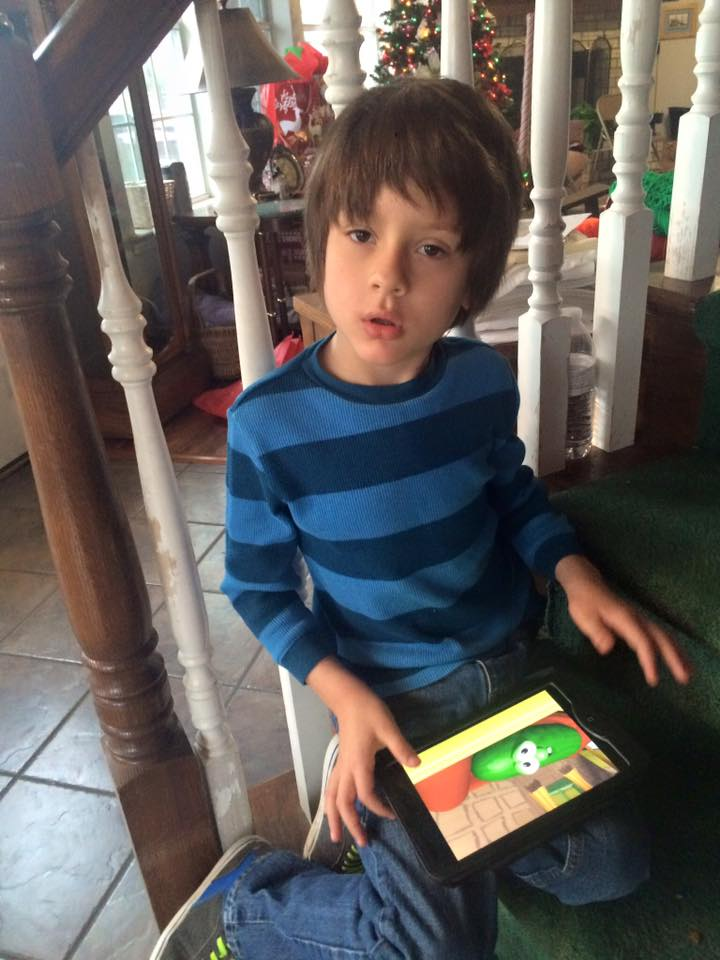
“We’re all gonna die!” screams a VeggieTales pea from his iPad. 


I don’t take my eyes off the road. “I’m not driving that fast, can you chill?” He giggles at his little joke and kicks his feet, playing the clip a couple more times. He is just as tickled every time. 


“What kind of donut do you want?” I ask as though I do not know the answer. 


“Ch-ch-ch-ch-ch.” Rhett’s response sounds like cheerful little maracas, rhythmic as a shimmy. 


“Chocolate? Again? They have so many good flavors, we could try something new. Like sour cream, or blueberry. You like blueberries.” 


He grinds his teeth loudly, the muscle working in his jaw. I’m transported back to early mornings on the lake, where the catfish call is so pronounced I can almost smell the bait. “Dude, can you stop? You’re making my face hurt just listening to it.” He chops one hand across the other. “Yeah, stop. All your teeth are gonna fall out.” He wasn’t agreeing with me though, just repeating; the grind continues until I hand back a silicone Lego necklace, an acceptable substitute.


The donut shop is brightly lit and overtly pink. It reminds me of the Barbie book I had as a kid where she opened an ice cream shop. The smell is yeasty and sweet, permeating the whole building. Rhett bounds up to the counter and loudly, proudly requests “DUH-uh!” 


A middle-aged woman is at the counter. She looks shocked for a minute, but turns on a hundred-watt smile. Speaking slowly and enunciating clearly, she says to him, “HELLO THERE. ARE…YOU….HERE…WITH…YOUR…MOMMY?” 


Rhett rocks back on his toes for a second. He is looking at the woman as if she is going to rear back and bite him. Nevermind that he has several inches and thirty pounds on her. I come up beside him and the woman turns her full attention on me as though Rhett suddenly vanished.


“Welcome to Bab’s Bakery, what can I get for you?” 


I turn to Rhett and ask “chocolate?” He doesn’t look at me as he whispers “ch-ch-ch-ch-ch.” 


“Can we get an order of chocolate donut holes? And a decaf coffee, black.” 


Bab starts punching in the order and filling the bag. “How old is he?” 


“Oh. Um. He’ll be 16 at the end of the month.” 


“16! He’s so tall though! My Chaz didn’t get that tall, but I suppose neither am I.” She gives a little chuckle. ``16 though. My gosh. Has he always been…” she trails off significantly, but I refuse to bail her out. “You know….like this?” Her voice has dropped to a conspiratorial whisper. 


My smile feels as thin as nori, and just as friable. “Yup. He was born this way.” 


“Oh, well bless your heart. I don’t know how you handle it. My friend Deb had a daughter who was, you know we didn’t have a name for it back then and everybody nowadays it feels like has this or that, but anyway: Deb’s girl, Ruby. They had to put her in one of those homes where there’s other people like her, and I mean, I heard it was nice; it wasn’t one of those bad ones. Ruby got to do arts and crafts and I think they had movie nights and she had her own room. Are you going to put him in a place like that? Your total is $4.58, dear.” 


I hand her the five I’ve been holding and take the coffee, squeezing it just a little too tight so the lid pops off. “We haven’t really discussed it.” Rhett rocks back and forth on his feet, staring out the window. He’s very quiet, and one hand has wound its way into his hair like he hasn’t done since he was a baby. 


Bab continues on as she punches buttons on the register, “well, better sooner than later. Y'all come back and see us sometime! GOOD…. BYE….. BUDDY!” she half-screams. 


Rhett carries the little baggie of donut holes to the car, dropping it on the floor and ignoring it. Donuts roll out on the floor. I don’t correct him as I back us out of the parking lot. 


We drive home in silence.


Thursday, March 1, 2018

The Price of Being Different


I hate spending money.

It is the possibility I am reluctant to part with. In my pocket, $20 could be a pack of diapers or a half a tank of gas or a couple of groceries. Once you spend it, all the possibility dissipates. Since I was little, I have preferred saving to preserve option to spending. Spending feels so final, so...decisive.


The topic of money is vulgar to me. Don’t like to talk about it, don’t like to think about it. Do not care for the fact that it is an unavoidable, definitively adult undertaking. It is kind of like toilet paper to me--everybody uses it, each in their own way, but please let’s not discuss the particulars, shall we?


Money is distasteful. On “Cutthroat Kitchen” when the contestants are first handed the cash, what do they always do? They raise it to their face and inhale that horrid smell. The smell of books, new or old, now that is intoxicating--it is the smell of adventure, prose, romance. The smell of money is sweat and butts and squandered potential.


So, if I dislike it so much, why talk about it?


It is one of the things people are most curious about. Probably because it is a borderline taboo subject--it would be impolite to inquire about someone else’s finances, in any scenario. We know the statistics though. Raising a child with special needs or chronic medical concerns is hair-raisingly expensive and we have three. I have panic attacks when confronted with it because need is where possibility and decision collide--inaction is rarely an option.


We have been incredibly blessed. At exactly the right time, the Lord has provided for us, through the kindness of others or an open door, talking to the right person at the right time that points us in the right direction. He has guided us through.


It is a substantial consideration on our part, whether I like it or not, a determining factor in a lot of our decisions. I figured I would offer you a glimpse of the inner workings here, some of the elements at play.


We are a single income family. I have been unable to work, largely due to Gabriel but also because of Benjamin and more recently, Tula. Daycare runs about $35 a day for a decent one, but in this town, the waiting lists are substantial for any reputable child care in town. It amounts to $500-$600 a month, or the bulk of anything I would be able to bring home. Jobs that have the same hours as school can be obtained, but I have to be available to pick up kids afterward or pay for after school care, which would deplete the rest of whatever I could earn. There are no after school programs that accept children with disabilities; there are no after school programs that can manage the girls’ diabetes.


If I could work, Emerald and Tula have to have doctor’s visits every three months; Gabriel has to have doctor’s visits every three months in Lubbock. Which accounts for at least three missed days of work--one to travel to Lubbock, one of the doctor’s appointment, one for the girls if I take them both at the same time--every three months. Those are specialists, they still have to see their regular pediatrician, and like any child they will get sick occasionally.


Gabriel’s school calls an average of two to three times a week for me to come up there. Children with autism often present with chronic gastrointestinal issues and Gabe is not exempt, so often he has had a bad poop and I have to bring him home to shower and return--sometimes it is a blowout, sometimes he gets into his diaper and smears it. Disgusting, but it is something we have to deal with. Other reasons they call are because he is agitated and not calming himself down, he is being aggressive, he is having issues with his clothes or shoes and needs me to deliver new ones, he is falling asleep and cannot keep himself awake, or because he is “just not acting like himself”. Between me and Michael, my hours off are quantifiably worth less than his, so I end up taking off again and again.


Let’s establish--that is just out of the ordinary stuff, not accounting for school trips or class parties and other parental involvement activities, most of which I am still unable to attend because siblings are not allowed (after all, I am of limited help when my arms and attention are full of baby).


We’ll do Diabetes first because I am holding Tula so it makes logical sense to me.


Insurance will cover 100 test strips--the little strips that we use to monitor the girls’ blood glucose levels--a month. Emerald has to test her sugar a minimum of four times a day, six on PE days, for a total of around 140 test strips used a month. Tula has to test her sugar around 6 times a day, for a total of 180. That is if we never get an error reading or they never have high or low blood sugar and never get sick--those all call for additional strips. The test strips we buy--the cheapest on the market--are $0.18 each, for about $40 out of pocket a month after insurance covers $60. Glucometer, the meter that reads the blood sugar, can vary. The ones we use at home the pharmacy actually gave us for free because insurance won’t cover those particular test strips (Glucocard). Insurance prefers the Tru Metrix test strips and meter, so we have two meters for each of the girls at home--one that uses the test strips insurance covers and one that uses the less expensive test strips we have to pay for out of pocket.


To complicate matters, Emerald actually has a THIRD glucometer at school--ReliOn Prime--that we provide test strips for. It is a cheap one, only costing $15 so it can be replaced as needs be.


Tula also has a third monitor, but that one is a combination Ketone and Glucose monitor that we only use for the former purpose. Whenever the girls’ blood sugar is over 300 or whenever they are getting sick, we have to check for ketones in their blood so they do not go back into ketoacidosis. Emerald has strips that you check her urine with; Tula has one that checks her blood. Neither of those are covered by insurance. Tula’s NovaMax Test Strips are around $2 a piece, but will last a few weeks because she doesn’t go high very often. Emerald’s are considerably cheaper at about $0.15 each, but she has to be tested more frequently. Combined, it is about $37 a month.


Lancets are cheap--we use them to poke fingers and toes to draw little bits of blood for testing blood sugar. They run about like $5 for a box, but insurance covers those and they last forever. Alcohol swabs run out quickly and are not covered, $2 for 100 for a total of $8 a month. We use those to clean before we prick or poke and wipe off the top of the insulin. Diabetes logbooks were $5 each and last the whole year. Emergency sugar supplies are like packets of sugar or honey that we have leftover if we eat out, but we could also put dum dums in there. Negligible stuff. Pen needles are the mini needles we put on insulin pens; they are $9 a box of 50 generic. We have to buy four of those a month--insurance covers $36, we cover $36.


Syringes, which we have to use for Teeny Tula’s half dosages, cost $30 (covered) a month.


Insulin gets tricky. Medicinal insulin has been around since the 1900s, so you’d think it would cost less. Generic will actually raise your insulin resistence, meaning you will need more and more over time. We invest in the better stuff. Both girls have Lantus Solostar pens, which are $280 a box. A box has six pens, each with 100 units of insulin. One box will last Emerald a little over two months. Tula has a vial of 100 units that costs $190; it will last her about a month.


Insulin is only good out of the fridge or open for a month so we have to toss it after that or it can jack with their sugars.


That is their long acting “basal” insulin. The also have bolus insulin--Emerald has Novalog Flexpens that are $600 for a box of six pens. Those will last us about a month because she has to take it more frequently, after each meal and for correction. Tula is on Humalog pen that is about $550, but because she eats so very little carbs and only gets the tiniest little doses, it will last her a while.


They both have to have the glucagon emergency kit in case they crash. Most families do not have to use it, but you always have to have it on hand and replace it once a year. It is sort of like an epipen. They are $300 apiece. Zofran is a medicine that will prevent them from vomitting when they are sick because it could cause them to crash which would be dangerous; we get a supply of that a year for $250.


So just for medicine and supplies, most of which is covered (thankfully) under our insurance, runs us about $24,000 a year for both girls. We are personally responsible for about $1500 of that, if insurance is playing nicely and there are no issues.


Emerald’s insurance lapsed last year so we had to pay for it out of pocket for a while; that was kind of killer. I thanked God every day that we were able to do that.


Visits to the endocrinologist happens for each of them every three months; we have no copay, but the visit would be around $120 because they do discounts if you pay up front. That adds up to $960 a year for both. Each time they go, they also have to run full blood work including a1c, totalling around $1000 or $8000 for the year. We meet with the registered dietitian at each visit ($100 an hour, times two for each girl, times four visits a year for a total of $800 a year). If there are no hospitalizations and we keep up with our routine office visits, that is just shy of $10,000 a year.


I don’t want to get into hospitalizations because YIKES and because I am sincerely hoping none of that happens. Normally, we will make an emergency room run once a year because we can’t get things under control and they need fluids or if we run out of insulin before insurance is willing to cover it again. Depending on what needs to be done, an ER visit will set us back about $1200. I also won’t go into things we are not currently doing, like special camps or insulin pumps or continuous glucose monitors because while I could look up the information on that, it would be meaningless--they do not currently affect us.


Whew. That was a bit of an odyssey. Catching my breath before I move on to Autism.


Alright, took a quick Facebook break and now I am back.


Autism Speaks estimates it takes around $60,000 a year to raise a child with autism; $90,000 if the individual also has an intellectual disability. That is roughly four times higher than the cost of raising a neurotypical child.

I did the math after a friend of friend asked me. All things considered, Gabriel costs $46,000 a year more than Benjamin. That is counting incontinent supplies, medication, specialists, therapists, personal care services. Breakdown is something like this:


-Personal Care Assistant: $1000/month ($12,000/year)


-Incontinent Supplies (diapers, wipes, changing pads): 200/month (2400/year)


-Medication (clonidine, risperidone, hydroxyzine): 450/month (5400/year)


-Therapy (speech, occupational, physical): $28,800/year*

*This one actually went down substantially because we cut back—insurance doesn’t cover Applied Behavior Analysis so we had to pay out of pocket for each session; got too costly and we had to quit. We also scaled back, dropped PT at home, decreased at PT/OT school so that he could have a little break. It was getting to be a lot.


-iPad maintenance and repair: $130/few times a year. Because it’s his communication device, we have kept it available, but that means it has had a few accidents. He ruins cases, takes it into the bath with him, leaves it outside, or gets mad and cracks the screen. Currently, he’s taking a short break from screens because he has annoyed us too greatly by being uncareful. It also covers new chargers.


-Specialists: $250/visit($1000/year) he see a developmental pediatrician, which we have to travel to Lubbock for, so tack on another $40 in gas.


There are other costs like locks for the fridge and pantry, bolts for the front door, back door, and our bedroom door. We get items to work with him between therapy—trampoline, swing set, weighted blanket, compression garments, sensory brushes, hammock, exercise ball, privacy pop, noise canceling headphones. Those vary in price from $10 to a few hundred. We were doing horse therapy for a while, but have taken a break. That was at no cost.


All of that adds up to...right under $50,000 annually for Gabe, before calculating for lost wages. As he gets older, the price will increase exponentially to include a nurse or residential living (though we hope he wants to stay with us), transportation, and other expenses.


I try not to think about all of this, but when it comes together…


Yuck. No wonder I don’t like thinking about money.


When I do think about it...it’s a tangible, definable way to express how God has cared for us. A lot of families of special kids go bankrupt trying to handle it all; though we rarely have excess, we always have what we need when we need it. I think that is such a beautiful thing. I am very thankful for it, because it once again opens my life up to possibility.


—Andie

Sunday, August 20, 2017

Retarded

I remember the exact day I became physically, consciously aware of the word “retarded”.

In high school, my algebra teacher patiently explained to the class that she would not tolerate the use of retard or retarded in her room, saying that it was hurtful. I didn’t understand at the time. Old people are so sensitive, amirite? They just don’t get it. I don’t mean anything by it. I’m not a hateful person, don’t look down on those that are differently abled. My intentions bought my absolution.

Several years later--June 23, 2011 to be exact--we were driving home from Dr. Driskell’s office in our worn-out Jeep with holes in the seat. My phone at the time was a Motorola Razr 2 in bubblegum pink that made that satisfying -clack!- when you slammed it shut, but cost a fortune per megabyte to look anything up on the painfully slow internet. We were going to have to wait until we got home to get on Michael’s computer and research this new-but-familiar word, Autism.

Back then, we knew nothing. Misconceptions at best. Google, unfortunately, would not be much more helpful as no one can agree on anything regarding the issue (at least it feels that way).

We could see Gabriel in the rear view mirror behind us, placid and content staring out the window at the houses passing by. One hand was in his straw-colored hair, the other holding on to the pacifier he was chewing on noisily.

Our baby.

Michael hesitantly asked, “Does this mean….is he retarded?”

It was a fair question. This was actually at the cusp of a big change to the Diagnostic and Statistical Manual of Mental Disorders, the fifth edition that would not only combine the subtypes of autism under the umbrella term of Autism Spectrum Disorder, but would replace the diagnosis “Mental Retardation” with “Intellectual Disability”.

(Note: the World Health Organization’s International Statistical Classifications of Diseases and Related Health Problems--ICD--still utilizes the term mental retardation. This is expected to change with the release of the 11th edition of the ICD, which is projected to take effect in the United States by 2023.)

Gabriel was first diagnosed in the summer of 2011 with classic autism: moderate to severe under the diagnostic criteria of the DSM-4.

Autism has a high rate of comorbidity--meaning two chronic conditions that are simultaneous in an individual--with epilepsy, ADHD, depression, anxiety, and intellectual disability, among many others. Intellectual Disability (ID) means limitations in adaptive behaviors (practical and conceptual skills such as social interactions, language, and activities of daily living) as well as a below average IQ. You can see how autism would often go hand-in-hand with that, as one key characterization of autism is impairment to adaptive behaviors.

So, when Gabe was diagnosed, the manual they used still held the phrase “mental retardation”, which he had a better than likely chance of being diagnosed with in the future.

In that moment, the word made a new kind of sense to me.

I can't say anyone’s intention behind saying phrases like “that's so retarded” or “don't be a retard”. Frankly, I'm sure there is little malice intended. A wise woman once told me, “you are an expert on your intent; I am an expert on your impact”. That's what this post is about, then. I can tell you the impact these words have on me, and likely on many more people affected by learning or intellectual disabilities and disorders.

After that day, the way those words are used, colloquially, casually to insult situations, behaviors, words, or people was no longer this innocuous, innocent ribbing. It was labeling something as inferior, worth less than our value.

We like to take words and repurpose them, meanings changing and adapting over time. When I say something is “cool”, listeners do not think I am referring to the temperature of the item; if I say “that sucks”, one does not assume the situation is creating a vacuum. Words are somewhat cheapened this way, being used to assign value or denote worthlessness instead of as descriptors. “Blonde” has much more usefulness to describe the shade of one’s hair, after all, than to imply unintelligence. There are so many other words--ignorant, senseless, foolish--that could have been used, but we insist on derisively saying, “ha! What a blonde!” Why?

When we categorize someone like that, we are unconsciously dividing it into an “us” and a “them”. If “they” are stupid/worthless/bad/wrong, then by virtue of not being them, the “us” are intelligent/valuable/good/right. It is much more pervasive than we realize once we become aware of it.

Our thoughts and our words matter. Proverbs 18:21 says “death and life are in the power of the tongue.” In Matthew 15:18, “But what comes out of the mouth proceeds from the heart.”

When someone says “retarded”, “retard”, or “-tard” words (ie, libatard), I feel it on my skin, a stab at a perpetually exposed nerve. Sometimes, I call people on it, if I think it will help. Most of the time I just flinch hard and exchange a look with Michael. He felt it, too. One thing we definitely never do is not notice.

It feels like every hateful thing people have thought about Gabriel because of his condition.

Like every struggle, every setback he has ever faced is being tossed back at him.

Like no matter how far he comes or how much progress he makes, he'll always be seen as inferior, broken.

Worthless.

Because when that word is being bandied about, it is not describing a chemical process. I hear that a lot, and my general rule of thumb: unless it is in a chemistry lab being used to actively describe a chemical process, then it's probably best not to use it. It has been co-opted from its original use like “cool” and “suck”...”faggot”.

My mother used to say, “Jesus knows what you want to say”. She was specifically referring to our teenage use of the word “freaking” as stand-in for a more colorful and exciting f-adjective. That has stuck with me because means that I need to be aware of the subtext and intention behind my words before I say them.

The DSM changed in May of 2013. The term MR was quietly laid to rest with the last edition. As of this post, Gabriel has not been diagnosed with Intellectual Disability. His developmental pediatrician has not even broached the subject, so he has no medical diagnosis of
it. At his 3-year complete Full Individual Evaluation (FIE) for his academic diagnosis, they suggested adding ID to his coding, but Michael and I politely and firmly declined. They tried to pretty it up and insist that it was something that could help Gabe, but I maintained that autism covered and explained the deficit in adaptive behaviors, but as he is unable to comply with an IQ test, it would be premature to affix an unproven label to him. AU gets him into Special Education and ensures his academic needs are being met; ID is not going to change that.

I can now definitively reply to Michael of 2011 that no, this does not mean Gabriel is retarded.

Doesn't stop me from flinching every time I had to write that hateful word for this post.

Because that is what it is, whether it is meant that way or not. It is a hateful word, one that has been hijacked from its original meaning and used as an insult, belittling. Regardless of intention, the impact is still being felt, keenly and unavoidably.

So please. Let this word die a dignified slang death.

Monday, February 20, 2017

Gabriel's 8th Birthday


My son, Gabriel, is a devious little imp.

He possesses a singularity of mind, a unique driven focus that allows him to get away with pretty much any scheme he can concoct.  


In our backyard, there is a large trampoline.  Gabriel loves to jump on the trampoline, he’d stay on it all day if we allowed him to.  But occasionally, the time to jump has past, and it is time to come inside. Gabriel and I often disagree as to when that time should come.  However, I am bigger than he is, and can usually throw him over my shoulder to bring him inside.  


This is does sit well with Gabriel, and so he begins to put his plan into motion.  You see, Gabriel is quite clever.  Almost disturbingly so.  Through a long set of trials and errors, he has determined a series of facts.  He knows that Daddy will come running if he hears a loud crash at the other end of the house.  He knows that Daddy will come through the main hallway, instead of the side route through the kitchen.  He knows that Daddy will spend at least a few seconds scanning the room, looking for signs of injury.  And lastly, but most importantly, he knows that the front door will be unguarded during that time.


And so he waits for me to get comfortable in my chair, and then climbs behind his dresser.  He pushes, with his back against the wall, and the large heavy dresser topples, making a terrible noise.  Immediately, he ducks into the kitchen, narrowly missing Daddy as he comes down the hallways to investigate. He slips into the living room via the kitchen entrance, unlocks the front door, and is outside.  By the time Daddy realizes that he’s been duped, Gabriel has run around the side of the house, scaled the fence, and is back jumping on the trampoline just in time to giggle at Daddy as he comes out the back door.


It does not matter that Daddy will simply pick him up again and carry him inside.  In fact, at this point he will willingly and of his own determination walk back inside himself.  Because he won.  HE decided when it was time to come inside, and made a fool of Daddy in the process.


As our regular readers know, Gabriel has Autism, and enough has been said on that subject here that I will not rehash it.  Instead of talking about Gabriel’s ‘condition,’ I’d like to talk today about who he is outside of that diagnosis.  And on that topic, I’d like to rehash what I stated at the beginning.  My son, Gabriel, is a devious little imp.


He is also the most affectionate child I have ever met.  Anyone who has ever met Gabe has been on the receiving end of genuine, heartfelt hug.  Most do not escape his grasp without a big wet kiss as well.  He loves to be held, and he shows a certain empathy and compassion for others in this, because he assumes that everyone else does as well.  He goes out of his way to make sure you know that he loves you, regardless of how long he has known you.  Without ever making eye contact, he will find you and sit in your lap, cuddling against your chest.  He appreciates physical contact, and he assumes you do as well.


If you ever do manage to make eye contact with him, you immediately notice a fierce intelligence behind those twinkles.  His mind never rests.  He is constantly scanning the room, marking the exits, looking for people that will and will not let him get away with his tricks.  If you are eating something that he likes, you’d better guard it well, because the second you set it down, he will be keenly aware.


Gabriel loves to eat and drink, he loves to run, and he loves to laugh.


I think we all could learn a lot from him.

Happy Birthday, Gabriel.  Daddy loves you.

Wednesday, December 7, 2016

Bumblebee's Greatest Hits


The goal of communication is to have your needs met--babies cry, which they learn parents will respond to promptly with food and clean diapers and whatever else tiny baby hearts might fancy.

When we hit the metaphorical wall where the manner in which we were expressing ourselves can no longer adequately satisfy those needs, we have to adapt, figure out a new way to get what we want. The same goes as we grow and develop more complex desires not as easily conveyed.

Gabriel, the exceedingly clever duckling that he is, has had to constantly devise of new and more elaborate manners in which to express himself without formal, traditionally acceptable communication (words, signs, picture exchange, etc). He will drag us to where he wants us to go and put our hand on what he is requesting, mime the action that he wants us to take, or bring the desired object to us.

His latest and most ingenious communication method has earned him the nickname “Bumblebee”.


Of the “Transformers” mythos, Bumblebee is an autobot that has been depicted as having a battle injury that resulted in the loss of his voice. In the Michael Bay movie, Bumblebee utilized cobbled together expressions from radio transmissions and songs to gain some semblance of speech.

With a remarkable memory for what he has watched and access to almost unlimited video material on his iPad, Gabriel has often found just the right phrase to repeat again and again in a given situation to communicate his thoughts on the matter. This has led to some funny, heartwarming, and overall impressive interactions we would have otherwise missed. So I present to you: Bumblebee’s Greatest Hits

Scene: Michael has just served a beef fajita dinner that he prepared.
Line: “I’m not going to eat garbage, Dad” (Ratatouille, 2007)

Scene: Michael, Gabriel, and I are driving to Lubbock to visit Michael’s family.
Line: “We’re all gonna die!” (VeggieTales: Pistachio, 2010)

Scene: The speech therapist was annoying and frustrating Gabriel by making him work; after he got his iPad back, she asked if they were still friends.
Line: “Since God has forgiven us it’s true, You forgive me, I’ll forgive you” (VeggieTales, “The Forgiveness Song”)

Scene: Having woken at the exceedingly appropriate hour of 2 am, I made Gabe lay still and quietly next to me in bed until 6.30 when I let him get up. I set him up with breakfast and gave him his iPad.
Line: “That was the WORST night of my life, BAR NONE” (Monsters Inc, 2001)

Scene: I have just served Gabriel lunch.
Line: “Ah, it’s the thought that counts.” (VeggieTales: Lyle the Kindly Viking”)

Scene: ???
Line: “master made me this collar so that I may speak” (Up, 2009)

Scene: My mother, who has been serving as our personal care attendant, frustrated Gabe by saying he was all done with snacks.
Line: “Bye!” (VeggieTales)

Scene: Emerald and Gabriel are playing together in his room.
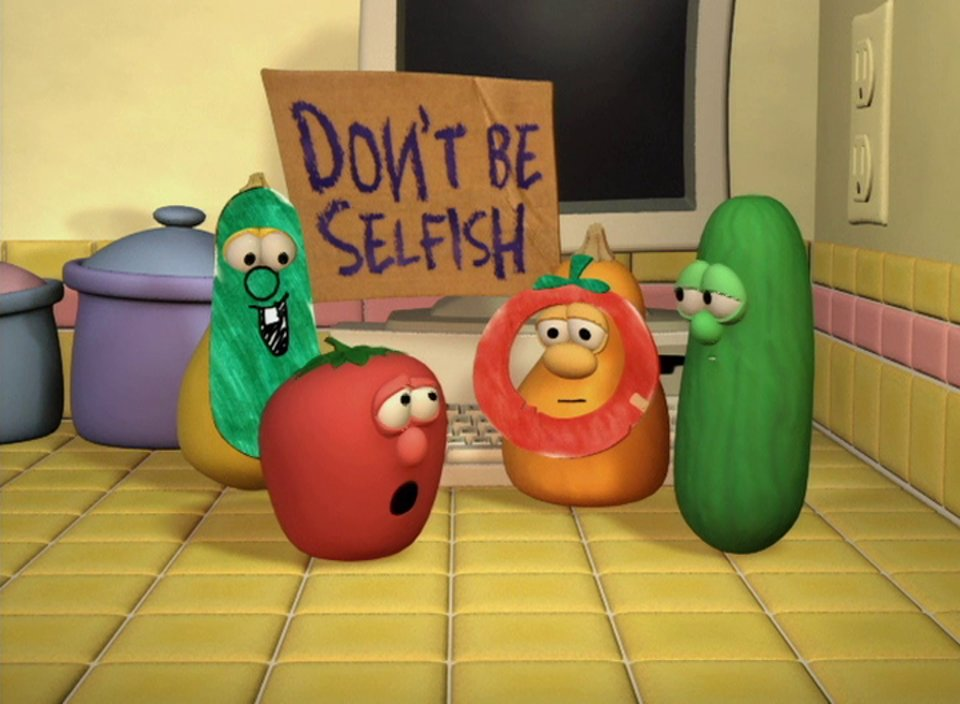
Line: “Oh! Would you look at that? Don’t be selfish” (King George and the Rubber Ducky)

Scene: Gabriel was having a rough morning emotionally, lots of meltdowns; we got Taco Bell for lunch so we wouldn’t have to cook.
Line: “I feel really happy and I don’t know why”. (Minnesota Cuke)

Line: Just like my mom and dad, they love me very much. (VeggieTales).
This was repeated until Michael said, “mom and dad do love you very much, buddy”.

Scene: Following Emerald around the house.
Line: “God gave us families to help each other. The very best way for you to show love to your new little brother is to think about him first.” (Duke and the Great Pie War)

Sunday, September 11, 2016

An Inclusive Church

inclusivechurch.png


At the October REACH community meeting, I am the speaker. As with most things I do, I am not really certain how I ended up in the place, likely from a single offhanded comment that I enthusiastically ran with, but I have thrown myself into it with my usual vigor.


The subject is “An Inclusive Church”--making churches safe and welcoming places for individuals with special needs.


I am FAR from an expert on the subject. I have no formal training of any kind on really any matter. That part is kind of making me nervous. Public speaking doesn’t bother me; I get antsy right before, but once it comes down to it the combination of my extensive research and practice combined with my inherent passion and earnestness wins out.


Above all, I want to have something worthwhile to say. This conversation needs to happen. Statistics have shown that 90% of families with a disabled member do not have a church home. When you’re talking about nearly 1 in 5 American families, that is a genuine problem.


What is keeping these families out of the church? What can we do to fix it?


What makes me think that I will have anything worth hearing to say on the subject?


I do have my own experiences--one bad, three good--since Gabriel was diagnosed. My observations. And one sad fact: I do not know a single special family, my own included, that has not been asked to leave a church.


We wanted the kids to grow up going to Sunday school like we had, but we were having trouble finding the right fit for our family. Michael and I were young, 24 and 22 respectively, and our religious beliefs were still solidifying, not yet quite fully realized. Both of us grew up in the Church of Christ, learning roughly the same basic traditions and beliefs and practices; we expanded on our well of knowledge at LCU with more challenging advanced theological study (Michael being a youth and family ministry major for several years, he was exposed to more than I was). We were at the point of sifting through all that we were taught and holding it up to our own interpretations to see if we could figure out exactly our particular brand of Christianity looked like.


In Lubbock, I can remember maybe four or five big Church of Christs. We chose ours based on proximity more than anything else, I would imagine. Being relatively awkward socially, I struggle bonding with new people and I had not made friends; Michael is reclusive by nature and is comfortable being on the outside looking in. So though we had attended off and on for a while, we really hadn’t connected with anyone or found our niche.


It shouldn’t have hurt when they (kindly) suggested we worship elsewhere then. I remember sitting there, confused by the language and not really following what was being said. My ear hurt; was I getting an ear infection? I didn’t want an ear infection. What do they give you for one if you’re allergic to penicillin? That was what I was thinking while Michael held my hand and I nodded when it seemed to be an appropriate time and made vague sounds of consent.


At dinner at Michael’s parents later that night, he was telling them how the kids would not be welcomed back to the church’s parents-day-out program the upcoming semester, how they had suggested we would be more comfortable in a different congregation. I remember being confused, arguing with him. That wasn’t what they said, was it? I thought we were just discussing Gabriel’s problem behaviors again.


We had several meetings like that over the course of the year that he had attended there. They were scarcely productive meetings. I had found out a literal hot minute ago that Gaby was autistic--following their recommendation to pursue testing. They were asking me for tips and strategies on how to deal with it.


Why did they think I had the answers? They had more experience, knew more about it at this point than I did!


We would sit there in another one of those interminable meetings, discussing a plan like I knew what I was doing, wide-eyed and pleading because I didn’t know what to do and this was my life now. I didn’t have any answers, I didn’t know who did. This massive, scary thing was crushing down on me…..

...and they were telling us to get out.


No matter how kindly or well-intentioned that was, it SUCKED. They had told me I needed to get Gaby tested for this, and when I did and it turned out he had it, they didn’t want us anymore.


We were devastated. It is like being broken up with. Doesn’t matter that you knew they weren’t the one for you, that it wasn’t going to last forever. It still hurts when they say it is over.


There was a lot I didn’t like about that church. I remember wandering around that first Sunday looking for a class and no one seemed to notice or care that I was there. More sermons than not we had not necessarily agreed with. It wasn’t a bad church, it just wasn’t the right place for us. And the longer we stayed, the more obvious it was that we didn’t fit in.


It took us awhile to work up the courage to try the place they had suggested. Why bother? So they can kick us out, too? Besides, it is way across town and we have heard that it is fairly -whispers “liberal”-. Yeah, I don’t know. That doesn’t sound like the right place for us.


Emerald kept asking if we were going back to bible class though. That is a hard thing to listen to, but what is even worse is watching her face fall when you say, “Not today, honey” week after week. The death blow is when she just stops asking.


So we swallowed our hurt and pocketed our fear of rejection, and we showed up the next Sunday hoping for the best.


How so delighted they were to see us, like they had been standing there holding those doors open just waiting for us to come in all this time. The church is far from small, boasting hundreds if not thousands of members. But they noticed that we were new, and wanted to make us feel welcomed and wanted.


The special needs minister took the time to talk to us, get to know our family and introduce us to the other families like ours, making sure to invite me to the mom’s support group. No chance at being a shrinking violet here because there were so many people that wanted to talk to you, get to know you.


We went to that church for several years, until we moved from Lubbock to Abilene, and during that time I fell in love with it. The teachers for the adult classes were so intelligent and had such engaging discussions--no fluff-piece, baby food lessons. They wanted you thinking, talking, participating. We were making friends, both through the mom’s special needs support group and also through our bible class, who seemed like a big group of best friends.


They took such amazing care of our babies, too. Gabriel we never worried about, never once heard a negative word about. No more scary sit down meetings about how much trouble he was; they thought he was cute and funny and smart and genuinely seemed to enjoy having him in their class.


After Emerald was diagnosed, I thought it was going to be hard to leave her, but her teachers were caring and informed which gave me such peace of mind. Plus they actually had a doctor on standby during services in case of emergencies; how amazing is that?


That may have been the hardest thing to leave in Lubbock. We didn’t want to leave Michael’s family behind and LCS was a good community, but we were scared we were not going to be able to find another place like that one for Gaby.


On first moving to Abilene, we started going to church where my brother and his family plus my mother went, way out on the far side of town.


This church was culture shock, coming from such a big, well-funded congregation to this tiny little home-style country church. There were maybe 50 people, probably less, a good portion of them Jarrod and his group of friends. They made up for their numbers by having the biggest hearts though. It felt like a tight-knit little family where everyone had to work.


The preacher’s wife, an elementary school teacher, volunteered right away to be Gabriel’s buddy. She stayed with him in class and helped him participate, or took him for walks if he was getting too worked up and agitated. No one seemed bothered that he stole food and made messes, or that he was often quite loud during service.


I had already adopted this attitude that you see in a lot of mothers of special needs kids--an existence of constant apology. We don’t make eye contact and apologize profusely for behaviors we should have no reason to be sorry for, things we cannot help. We hold ourselves with a general air of being a burden, just by our being here because so often people are inconvenienced or annoyed by what our kids do. (Disclaimer: Obviously not true of every special mother.).


There is really two reactions to that: either you can get righteously indignant and fight, or you can bow your head and mumble apologizes. I am the latter.


At the beginning of going to that kind little church, I apologized a lot. For Gaby’s messes, for his noises. For Emerald’s outbursts. Sorry I came. So sorry. Sorry I am here. I’ll go now.


The longer we stayed, I stopped feeling like I had to be sorry because everyone was happy to see us, happy we were there. There was this guy that Gabriel just bonded with--no discernable reason other than he just liked the look of this fella, and every time we walked in the door Gabe would run up and give him a hug. He was content and making friends, and we enjoyed service. The members’ beliefs seemed to run the complete gamut, but they believed in friendly discourse regardless, which made for some thought-provoking discussions I enjoyed a great deal.


It was costing us a fortune in gas to get back and forth that we could not afford; circumstances led us to try another church, one that was just down the street from our house. And I mean that literally--if you stand on our front yard, you can see the church.


I went by myself the first time. My overall impression was positive, from caring, helpful people to a service that comfortably fit within my own ideals of church. I left a card requesting more information, describing our particular situation. That week, I got an email from two elders, the guy that helped me find a class (actually not certain of his official position at the church, but he seems to have a hand in just about everything), the preacher, and the children’s minister. The last one set up a time with me to come out and talk to us about Gaby and to meet him before we brought him in.


That right there, guys. That is what got me.


Everyone was so sweet in sending those messages, making me feel like they noticed and cared that I had attended and actually wanted me to visit again. But that children’s minister made it for me. She came to our house and said they would do anything they needed to do to make sure that Gabriel was taken care of and that we were happy and comfortable bringing him there. She listened, she asked questions. She made us feel confident with taking our special boy to this place, that he was wanted and celebrated and would be loved.


We all went that next Sunday, placed membership a few months later, and have been going ever since.


Another day assured us we made the right choice. I had posted on this blog how hard it was for us to go to small groups because of how difficult it is to feed us. An elder that Sunday came up after service and personally invited us--particularly Gabriel--to small group at his house that night, saying us we would be welcomed. We did go, and that invitation made a big impact on me.


It is hard to think sometimes how limited the choices of special needs families can be. Where our kids go to school or daycare, where we live and work, what restaurants and stores and fun places that we can go are all often decided for us because of how it will positively or negatively impact our child. Wouldn’t it be nice if our choice of church was not limited by who would and would not accept Gaby?


That is why I am speaking at the meeting in October. I want to start the discussion--get the thought into people’s minds. I won’t be telling this rather long story; that is really just for my own personal reflection. And to thank you, whoever is reading this, if you were part of one of those three churches that have been so good to us. It was because I saw how good it could be that made me want to help find that for every special family.


If you are in the area and want to come to this community meeting, you are more than welcome. Please RSVP at the email listed on the flyer; we will be happy to have you.

<3